
Blackmont
ETF Analysis
The ETF Screener and Optimization Tool provides a comprehensive and interactive section for analyzing and constructing ETF portfolios with precision. The screener enables users to filter ETFs based on critical metrics such as asset class, volatility, returns, and expense ratios, offering a detailed overview of available investment options.
The optimization feature employs advanced algorithms to create efficient portfolios tailored to specific risk and return objectives. By integrating key factors like diversification and performance tracking, this tool supports informed decision-making for a wide range of investment strategies.
With clear visualizations and robust analytical capabilities, the tool facilitates the comparison of ETF performance and risk profiles, empowering investors to identify opportunities and mitigate risks effectively. Whether for professional or personal use, the ETF Screener and Optimization Tool streamlines the process of portfolio management and optimization.
1. ETF Universe Overview:
This section utilizes a meticulously curated selection of Exchange-Traded Funds (ETFs) that spans a wide range of asset classes and investment objectives. The dataset includes ETFs from categories such as equities, fixed income, commodities, alternatives, currencies, and asset allocation strategies, ensuring comprehensive market coverage. These classes encompass diverse exposures, from broad market indices and sector-specific funds to thematic investments targeting innovation, sustainability, and emerging industries.
To identify the most suitable ETFs for investors, several critical factors are evaluated beyond traditional metrics such as volatility, returns, and Sharpe ratios. These include:
- Cost Efficiency: Expense ratios are carefully analyzed to ensure that the selected ETFs deliver value without unnecessary fees, allowing investors to maximize net returns.
- Market Tenure: ETFs with a proven track record and several years in the market are prioritized, ensuring reliability and consistent performance over time.
- Liquidity and AUM: High trading volumes and significant assets under management (AUM) are key indicators of an ETF's market efficiency and investor confidence.
- Performance Consistency: Historical data is scrutinized to identify ETFs that demonstrate stability and resilience across varying market conditions.
By integrating these factors, the tool offers a refined selection of ETFs that balance risk, return, and cost-effectiveness. This approach not only supports informed decision-making but also empowers investors to construct portfolios tailored to their specific objectives, whether they aim for growth, income, or diversification.
The ETF universe is dynamically updated to include the latest market offerings and ensure that investors have access to innovative strategies and emerging opportunities. With this robust framework, the platform serves as a reliable tool for navigating the ever-expanding world of ETFs.
2. Top ETFs per level of risk:
The Dynamic Landscape of ETFs: Patterns, Leaders, and Key Insights
Exchange-Traded Funds (ETFs) have soared in popularity due to their versatility and diverse offering. This analysis encompasses a myriad of ETFs with varying strategies and sectors. Key indicators such as return, volatility, and Sharpe Ratio are essential for understanding an ETF’s performance and risk profile. An in-depth exploration of these indicators across varying ETF classes is paramount for investors to navigate potential investment opportunities.
ETFs can be categorized into several classes, each depicting unique characteristics and investment philosophies:
- Defined Outcome: These funds, such as FT Vest U.S. Equity Enhance Moderate Buffer ET, leverage customizable options for downside protection and moderate returns. They often feature moderate to high volatility, as observed with FT Vest Laddered Moderate Buffer ETF (volatility: 5.24).
- Large Blend: Funds like LG QRAFT AI-Powered U.S. Large Cap Core ETF utilize AI-driven strategies for core growth, reflected in a stellar return of 37.45 with higher volatility at 12.3.
- Large Growth: High growth ETFs, such as WisdomTree U.S. Quality Growth Fund, which leads in return with 48.65 at 17.05 volatility, display higher deviation due to aggressive strategies aimed at capital appreciation.
- Large Value: These ETFs focus on undervalued companies aiming for consistent returns. The AB US High Dividend ETF secured a substantial return of 25.02 with a volatility of 10.87.
- Equity Hedged: With strategies such as hedging, JPMorgan Hedged Equity Laddered Overlay ETF shows promising returns of 19.97 with volatility at 5.91.
The analysis unveils intriguing patterns across the ETF spectrum:
- IDS shows a higher concentration of Defined Outcome ETFs. These tend to have moderate returns with carefully controlled volatility, exemplified by FT Vest U.S. Equity Moderate Buffer ETF.
- High volatility and returns are prevalent in the Large Growth sector, highlighting a natural risk-return trade-off.
- AI influence is notable in strategies like LG QRAFT AI-Powered U.S. Large Cap Core ETF, intertwining tech advancements with investment strategies for higher yield.
In mapping out the leading and lagging ETFs, several stand out:
- Leaders:
- WisdomTree U.S. Quality Growth Fund dominates with a high return of 48.65, reflecting strong growth metrics.
- Fidelity Enhanced Large Cap Growth ETF also performs exceptionally, boasting a solid return of 39.29 with considerable volatility.
- Laggards:
- Innovator Defined Wealth Shield ETF underperforms with a return of 6.01 but maintains low volatility, showcasing its defensive nature.
- Alpha Architect 1-3 Month Box ETF also trails with minimal returns of 5.11, aligning with its ultrashort bond strategy.
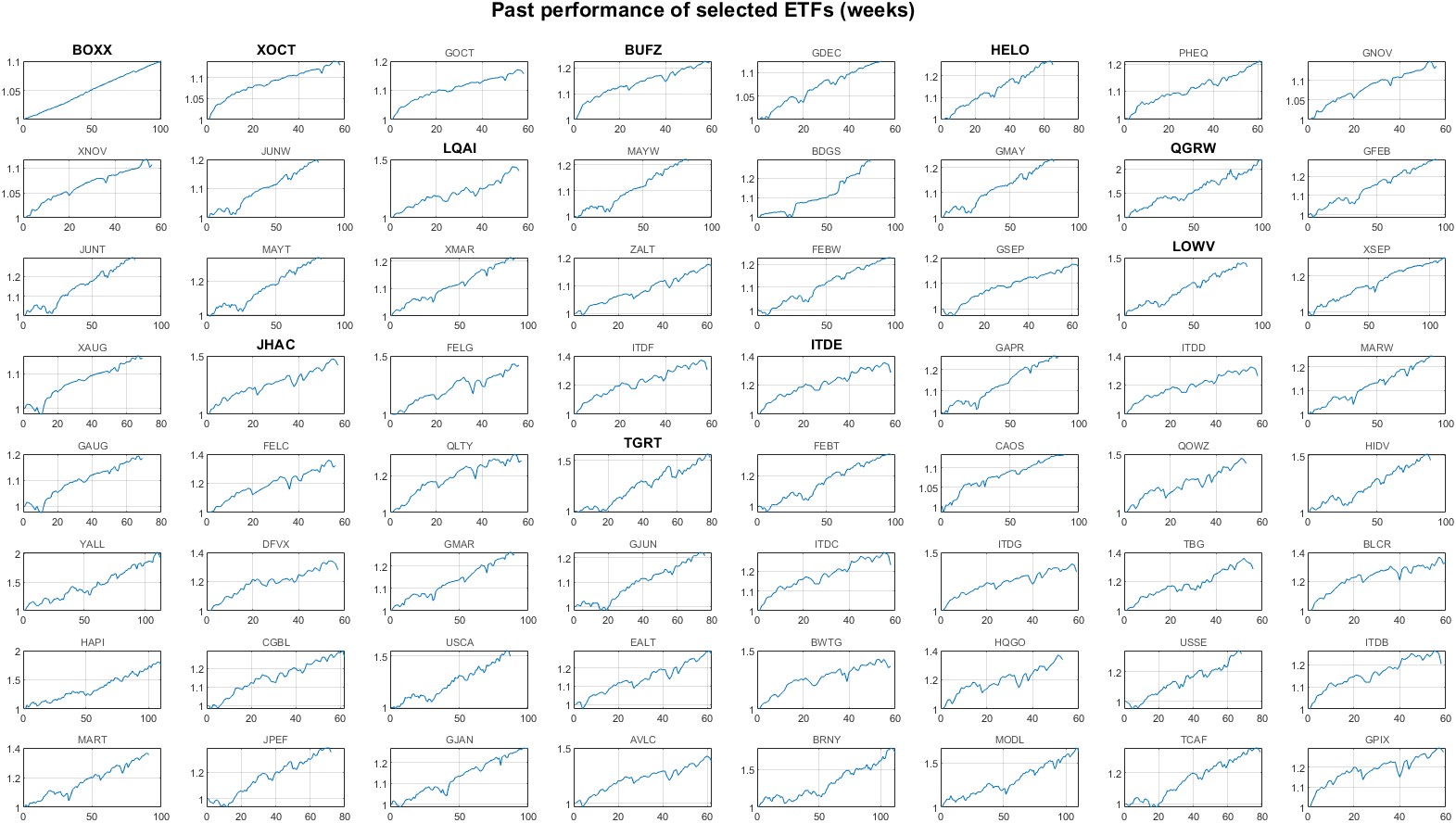
The ETF landscape is nuanced and complex. Recognizing the interplay of return, volatility, and market strategy is crucial. While funds like WisdomTree U.S. Quality Growth Fund show robust growth potential, others like Innovator Defined Wealth Shield ETF provide stability. Investors must align their risk appetite with their investment goals, as ETF performance can be influenced by shifting market cycles, technological advancements, and global economic changes. Vigilance and strategic diversification remain imperative in maximizing opportunities within the ETF domain.
3. Optimal Portfolios:
A Comprehensive Analysis of Optimal ETFs for a Diversified Investment Portfolio
As investors seek efficient strategies for portfolio diversification and risk management, a mix of ETFs emerges as optimal candidates due to their performance metrics and unique investment strategies. In this article, we explore a carefully selected collection of ETFs based on key indicators such as return, volatility, Sharpe ratio, and portfolio holdings. These metrics provide crucial insights into risk-adjusted returns and help in determining the attractiveness of each ETF.
Introduction
The selected ETFs span various investment categories, from equity to fixed-income and asset allocation. The ETFs analyzed include funds with distinctive focus areas, such as short-duration fixed-income products, defined outcome strategies, equity hedging techniques, AI-enhanced decisions, and growth-centric assets. Understanding these funds' return, volatility, and Sharpe ratios provides investors with the tools they need to gauge potential investment efficiency and performance consistency over time.
Analysis of the ETFs
-
Alpha Architect 1-3 Month Box ETF:
This Fixed Income ETF focuses on short-duration investment strategies using box spreads, offering a low volatility of 0.5% for a stable return of 5.11%. It's a suitable option for ultrashort bond investors aiming for reduced risk exposure.
-
FT Vest U.S. Equity Enhance Moderate Buffer ETF - October:
Targeting the equity sector with a defined outcome strategy, this ETF shows a moderate volatility of 2.99% and a significant return of 11.83%, with a Sharpe ratio of 3.96, making it ideal for investors who prefer moderated risk along with total asset allocation in FLEX options.
-
JPMorgan Hedged Equity Laddered Overlay ETF:
With a high Sharpe ratio of 3.38 and balanced volatility of 5.91%, this ETF provides exposure to broad equity markets while hedging market risks. Investors gain through an enhanced index strategy aligned with large-cap U.S. equities.
-
AB US Low Volatility Equity ETF:
This fund presents a compelling opportunity with a 23.07% return and a moderate Sharpe ratio of 2.53. It is ideal for investors aiming for consistent returns with less market volatility within large-blend equities.
-
iShares LifePath Target Date 2045 ETF:
Actively managing asset allocations, this ETF is designed for longer-term growth strategies with a significant return of 25.72% and higher volatility of 10.67%, suitable for investors focused on long-term growth aligned to a target date.
-
LG QRAFT AI-Powered U.S. Large Cap Core ETF:
Leveraging artificial intelligence for broad-cap U.S. stock selection, offers promising returns of 37.45%. Despite higher volatility of 12.3%, it signals strong potential for tech-savvy growth investors.
-
John Hancock Fundamental All Cap Core ETF:
This ETF displays a robust return rate of 38.29% combined with the highest volatility of 15.39%. It is appealing to those seeking broad equity exposure across market capitalizations, justified by strong growth drivers.
-
WisdomTree U.S. Quality Growth Fund:
With an impressive return of 48.65% and Sharpe ratio of 2.85 despite high volatility (17.05%), this ETF suits investors focused on quality growth in large- and mid-cap U.S. firms.
Conclusion
Each ETF analyzed provides unique opportunities based on its investment strategy, risk, and return profile. The key is to identify alignment with investor portfolios based on individual risk tolerance and return expectations. Fixed-income products offer lower risk, while growth-oriented and AI-leveraged funds present higher returns with increased volatility. Depending on investment objectives, a balanced ETF mix from different categories remains a prudent strategy for building a resilient, diversified investment portfolio.