
Blackmont
Blackmont's Analysis of the Sectors of the S&P 500
This section illustrates the heatmap percentile rankings of various financial and performance indicators for multiple companies (tickers) within a specific sector of the S&P 500. Each color represents a different percentile (1, 5, 25, 50, 75, 95 and 99) for metrics such as short ratio, dividend yield, market cap, and others, allowing a quick comparison of company performance across indicators.
Analyzing the Consumer Defensive Sector: Leaders, Laggards, and Key Indicators
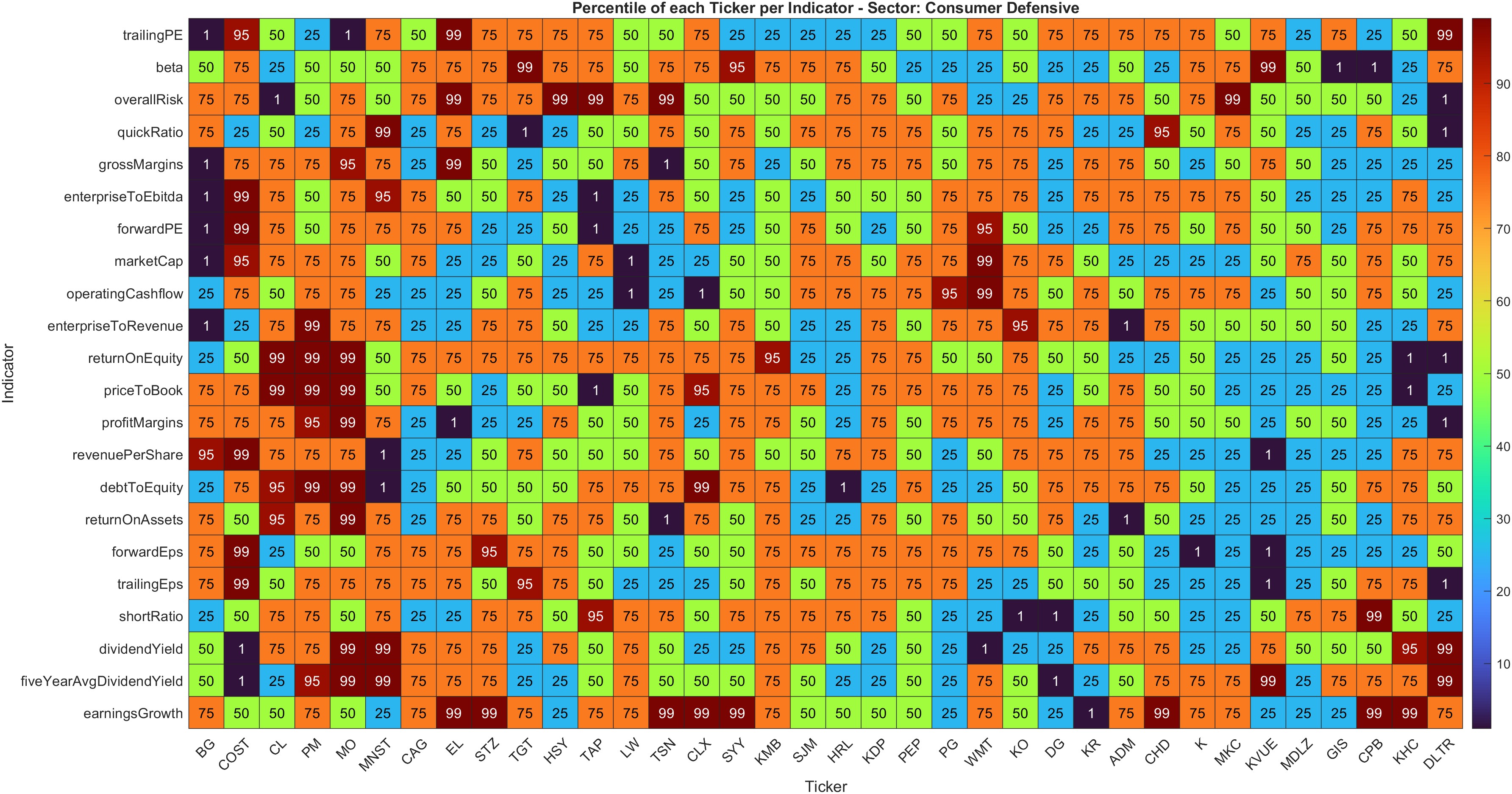
The Consumer Defensive sector encompasses companies that manufacture or sell essential products such as food, beverages, household goods, and personal care items. As a sector regarded for its stability, especially during economic downturns, Consumer Defensive stocks are often characterized by consistent earnings growth, reliable dividend payments, and lower volatility compared to other sectors. A thorough analysis of key financial indicators like earnings growth, dividend yield, beta, and others can provide valuable insights into the performance and potential of the companies within this sector.
Key Observations
An analysis of the heatmap reveals notable patterns and relationships between various financial indicators. For instance, the beta values across the sector show that while most companies maintain a low risk profile, a few companies significantly deviate. The maximum beta observed is around 1, suggesting that those companies are more volatile and may not be as stable compared to their peers.
The profit margins are quite informative, as they highlight the profitability levels of leading companies. Firms like Procter & Gamble (PG) and Coca-Cola (KO) report profit margins in the high percentiles, showcasing their efficient cost management and pricing strategies. This profitability directly correlates with their return on equity (ROE) figures, with both firms also demonstrating solid returns on their shareholders' investments.
Another noteworthy observation is the relationship between dividend yield and earnings growth. Companies offering higher dividend yields, such as Kraft Heinz (KHC), exhibit relatively lower earnings growth, indicating a potential trade-off between immediate income and long-term capital appreciation.
Leaders and Laggards
Within the Consumer Defensive sector, certain companies stand out as leaders based on their performance across several key metrics. Notable leaders include:
- Costco (COST): With high profit margins and a robust earnings growth rate, Costco indicates its operational prowess in the retail space.
- Pepperidge Farm (PEP): Marked by strong profitability and a consistent dividend yield, Pepperidge Farm remains a favorite among investors focusing on consumer staples.
- Kraft Heinz (KHC): Despite showing lower earnings growth compared to peers, Kraft Heinz maintains a high dividend yield, appealing to income-focused investors.
Conversely, the sector has its laggards that reveal the risks involved. Companies such as Kellogg (K) and General Mills (GIS) have relatively lower earnings growth and profit margins. These firms may need to enhance their operational efficiency or rethink their product portfolios to navigate a highly competitive landscape.
Sector-wide Analysis
The Consumer Defensive sector exhibits several interesting trends. One prominent trend is its resilience during economic fluctuations. Generally, consumer staples continue to perform well even when economic conditions are unfavorable, resulting in consistent earnings growth. This resilience reflects in the overall low operational risk scores that many companies in the sector have achieved, showcasing strong management strategies against market volatility.
Moreover, the sector has demonstrated a growing emphasis on sustainability and health-conscious products, impacting consumer behavior significantly. Companies adapting to these trends—such as Mondelez (MDLZ)—are likely to capture more market share moving forward.
Conclusion
The analysis of the Consumer Defensive sector reveals a mix of opportunities and risks for investors. Companies like Costco and Pepperidge Farm show the potential for stable investment given their solid fundamentals and growth prospects. On the other hand, laggards like Kellogg may need to revisit their strategies to improve operational efficiency.
As the sector continues to adapt to changing consumer preferences and economic conditions, investors should remain diligent in monitoring key indicators such as earnings growth, dividend yield, and operational risk to make informed investment decisions. The Consumer Defensive sector, with its inherent stability, remains a crucial element in a diversified investment portfolio.