
Blackmont
Blackmont's Analysis of the Sectors of the S&P 500
This section illustrates the heatmap percentile rankings of various financial and performance indicators for multiple companies (tickers) within a specific sector of the S&P 500. Each color represents a different percentile (1, 5, 25, 50, 75, 95 and 99) for metrics such as short ratio, dividend yield, market cap, and others, allowing a quick comparison of company performance across indicators.
Analyzing the Technology Sector: A Deep Dive into S&P 500 Performance
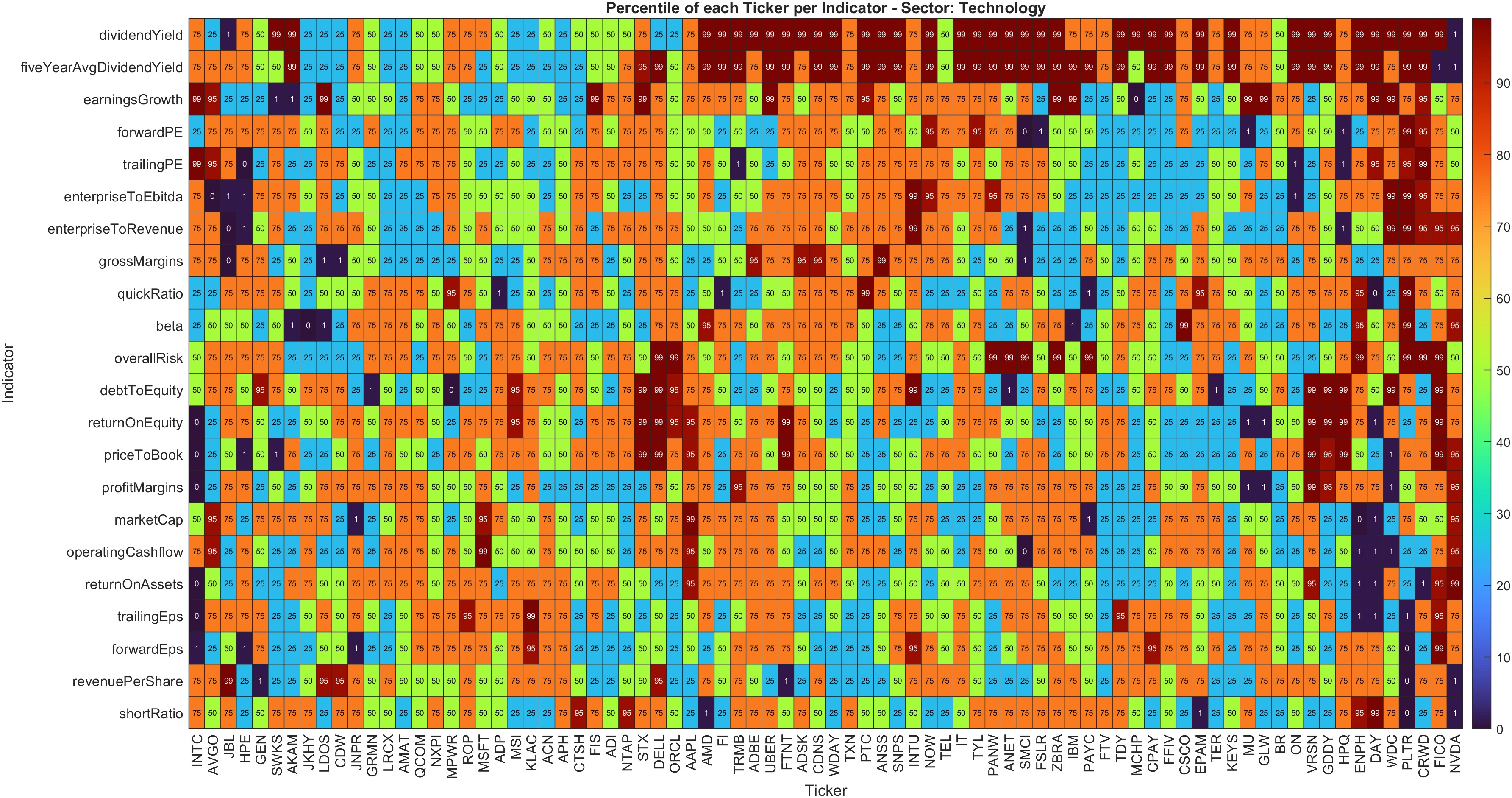
The Technology sector has consistently been a cornerstone of the S&P 500, representing innovation, growth, and significant investment opportunities. Understanding how companies within this sector perform relative to various financial indicators is crucial for investors looking to make informed decisions. Key indicators such as earnings growth, dividend yield, beta, and others can provide valuable insights into the health and future prospects of these companies.
Key Observations
- Earnings Growth vs. Price-to-Earnings Ratios: Companies exhibiting high earnings growth tend to have lower price-to-earnings (P/E) ratios, indicating potential undervaluation. For instance, firms like Apple (AAPL) show robust earnings growth, yet their trailing P/E is relatively moderate, suggesting room for price appreciation.
- Dividend Yield Trends: Most technology companies traditionally do not rely on dividends, which is reflected in the dividend yield percentiles where many are clustered in the lower ranges. Companies like Microsoft (MSFT) have managed to integrate dividends effectively, achieving higher rankings on the yield scale.
- Risk Assessment (Beta and Overall Risk): Financial metrics such as beta (a measure of volatility) show varying degrees of risk among companies. For example, Amazon (AMZN) has a higher beta, indicating higher market risk compared to Oracle (ORCL), which exhibits a more stable profile.
Leaders and Laggards
Within the Technology sector, certain companies stand out for their performance metrics, while others lag significantly.
- Leaders:
- NVIDIA (NVDA):
- Apple (AAPL):
Notably high in gross margins and market capitalization, NVIDIA is capitalizing on the AI and gaming markets, positioning itself as a prominent leader.
With strong earnings growth and a manageable debt-to-equity ratio, Apple continues to demonstrate financial health and investor confidence.
- Laggards:
- IBM (IBM):
- Intel (INTC):
Despite its historical significance, IBM struggles with low earnings growth and moderate margins, leading to challenges in maintaining investor interest.
Experiencing low percentiles in categories like profit margins and operating cash flow, Intel is facing intense competitive pressure.
Sector-wide Analysis
The Technology sector as a whole indicates several notable trends:
- Growth vs. Dividend Pay-Outs: A predominant number of companies focus on reinvesting profits rather than returning value through dividends, limiting opportunities for income-seeking investors.
- Increased Volatility: The sector exhibits significant volatility, with many stocks showing high beta values. This high risk is often accompanied by high reward, favoring investors willing to weather market fluctuations.
- Innovation-Driven Growth: Companies that continuously innovate, like Adobe (ADBE) and Salesforce (CRM), demonstrate strong earnings growth and improved operating cash flow, highlighting the importance of R&D and technology advancements for maintaining a competitive edge.
Conclusion
The current state of the Technology sector in the S&P 500 is characterized by a mix of high-performing leaders and struggling laggards, signifying both opportunities and challenges for investors. While leaders capitalize on innovative practices and robust earnings growth, laggards like IBM and Intel need to reevaluate their strategies to regain investor confidence.
Moving forward, the sector presents numerous opportunities in emerging technologies like AI and cloud computing; however, investors must remain aware of the inherent risks associated with high volatility and market changes. A balanced approach, focusing on both growth potential and risk management, will be crucial for anyone looking to invest in this dynamic sector.